$ cd ./blog
How the lab got here
The homelab started as a $75 school-surplus desktop and a router I had no business flashing. Seven years later it's a nine-node Kubernetes cluster. This is the arc, evolution by evolution, scar by scar.
Every homelab has an origin story, and most of them start dumber than the current setup makes them look. Mine started with a $75 desktop and a router I had no business flashing.
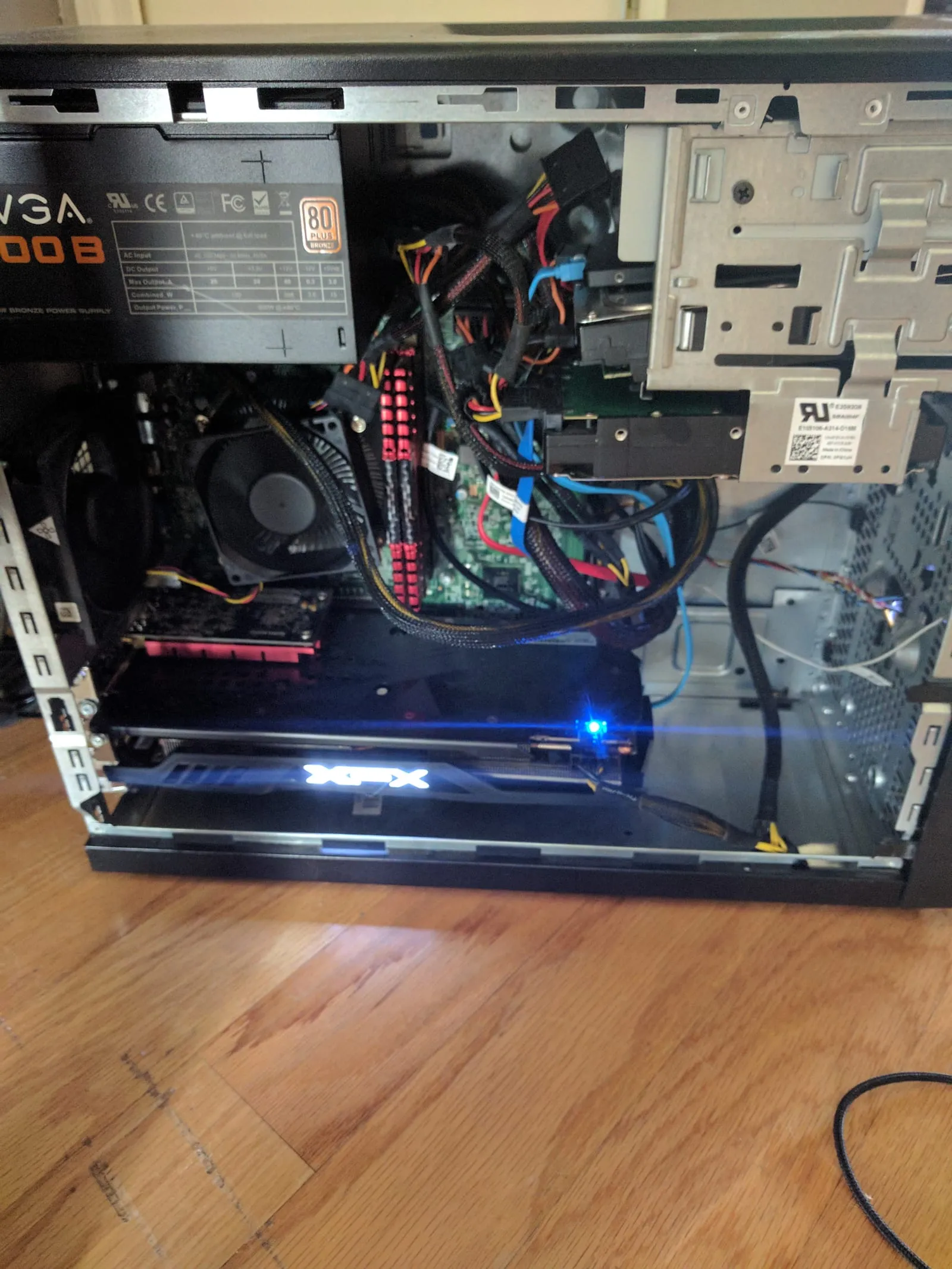
Not the lab. This is my personal PC from around then, with a box fan zip-tied on to keep an overheating RX 480 alive. This is the energy we are working with.
The $75 firewall
The first real piece was a firewall. I bought a slim HP desktop, one of those little corporate G2 boxes, from a local school that was clearing them out. Seventy-five dollars. I dropped a four-port gigabit NIC into it and turned it into an OPNsense box, then flashed my consumer router with Tomato so I could actually run VLANs and a few SSIDs behind it.
That box taught me the parts nobody enjoys learning: VLANs, addressing, subnets, the gap between “it works” and “it works the way I meant it to.” None of it was theoretical. Get the addressing wrong and the internet stops for the whole house, and you hear about it immediately.
This was also around the time I was clawing out of restaurant work. I’d been a line cook and a server, and IT was the thing I’d actually wanted the whole time. The A+ came a couple years later. The firewall came first, which in hindsight is the right order. I broke my own network before anyone paid me to touch theirs.
The whitebox
Once I trusted the network I built a real server, a whitebox running Linux Mint, around 2017. That’s where it turned into an actual lab.
I got into Plex and the whole *arr stack, mostly to get out from under streaming services that kept splitting the same catalog across more subscriptions every year. Then I stood up Docker, and it got out of hand fast. Thirty-ish services almost immediately. That’s also when I found the homelab community and GitHub, which is roughly like handing a pyromaniac a lighter and a grant.
A few things defined that era. Friends got in. I handed out Plex access and put Ombi in front of it so people could make their own requests and let the automation sort out the rest. It grew into a donation-only Plex service with around thirty users, and I added a GPU specifically to handle hardware transcoding once that many people were watching at once. Storage kept sprawling too. I bolted drives onto that box until it physically could not hold another one, which is what pushed me toward “unlimited” cloud storage. I landed on Google Workspace, and by the time I finally clawed back out of it I had something like 127 TB parked in their cloud. That is a whole story on its own, and it’s going to get its own post.
Around 2018 and 2019 I started taking home automation seriously. A growing pile of IoT junk, Z-Wave bridged into MQTT, and the slow realization that a smart home is just a distributed system living in your walls that occasionally refuses to turn on a light.
The machine that refused to die
In 2019 I built a Threadripper workstation. An ASRock Fatal1ty X399 Professional Gaming board, a Threadripper 1900X, a Noctua cooler roughly the size of a small animal, and a GTX 1080 Ti.
I bring it up because that exact motherboard is still running today. It survived every evolution that came after it and turned into pve-01 in the current cluster. The CPU got swapped up to a 2920X, the memory went to 128 GB, and it collected enterprise network cards along the way, but it is the same board I built on a desk in 2019. The 1080 Ti is still in it too, now passed through to a Kubernetes GPU worker. Seven years of continuous service across three completely different architectures. Not bad for a gaming board.
It started life in the 4U rackmount chassis. Later, when I needed ECC RDIMM memory and more PCIe lanes than the platform could give me, I bought the parts that are now pve-00, dropped them into that 4U, and moved the X399 out into the tower case from my old gaming PC. So the board has outlived its own chassis, and it is still going.
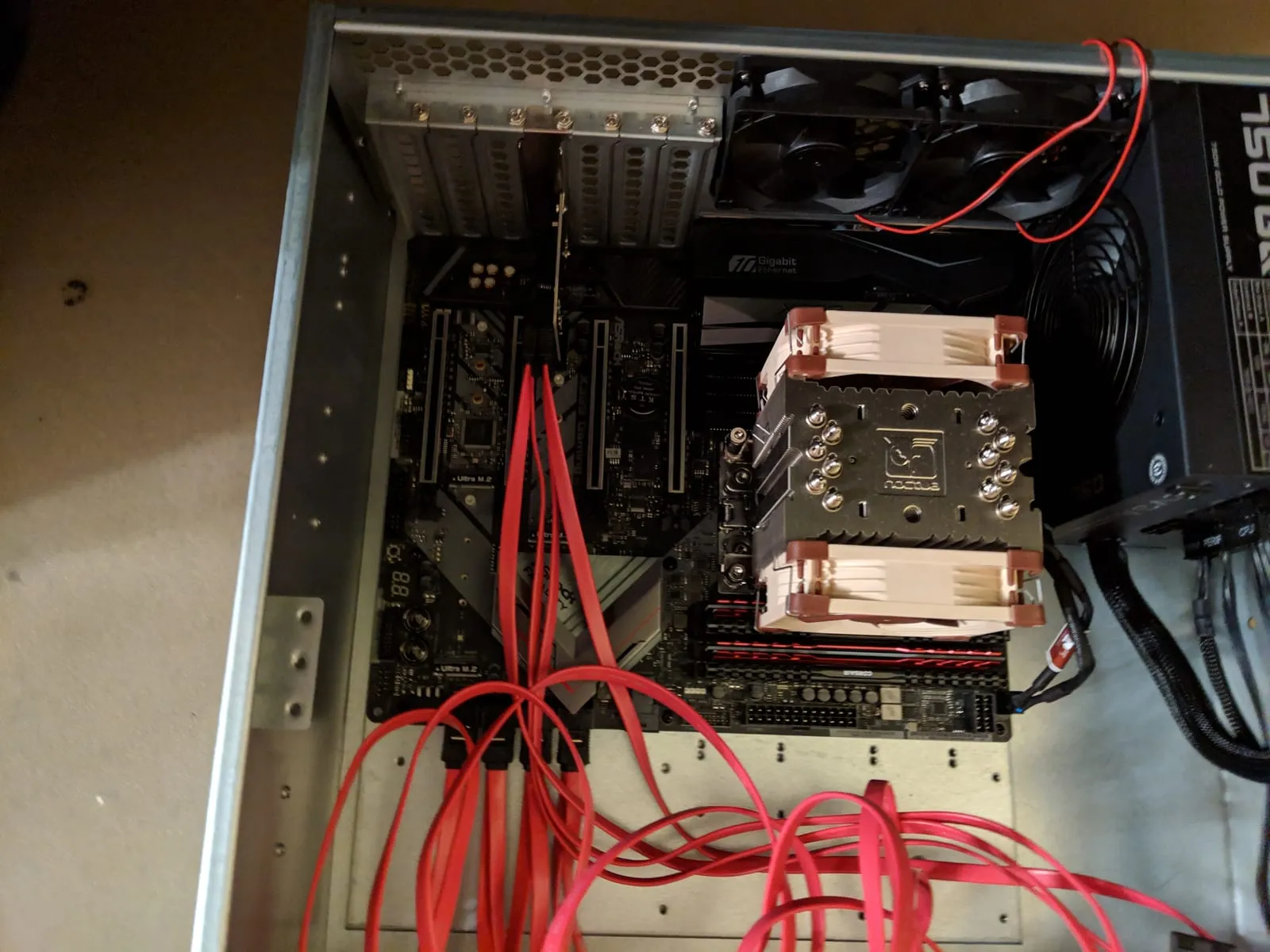
The X399 build in its original 4U chassis, 2019. The board still runs as pve-01, though it has since moved into a different case.
Why cluster at all
The honest reason I ever moved past one box: other people depended on it.
When it is just you, a server falling over is a personal annoyance. Once your friends and wife are streaming from it and your house’s lights and thermostats run through it, an outage is a support ticket, and you are the only person on call. I wanted fault tolerance because I was tired of being the single point of failure. That one requirement drove every jump that came after.
Proxmox and the rack
The move off the single box started by not throwing it away. I migrated the Linux Mint disk image straight into a Proxmox VM. The old whitebox got to keep living, just virtualized, and from there I started building out.
By late 2020 I was running a few HP mini PCs as light nodes. In February 2021 I built the first real rack and got everything off the shelf it had been living on. From there it was Proxmox, one node at first, then a couple, running Plex and a steadily growing Docker stack and the home automation. That setup carried the lab for a few years without much drama, which in this hobby counts as a golden age.
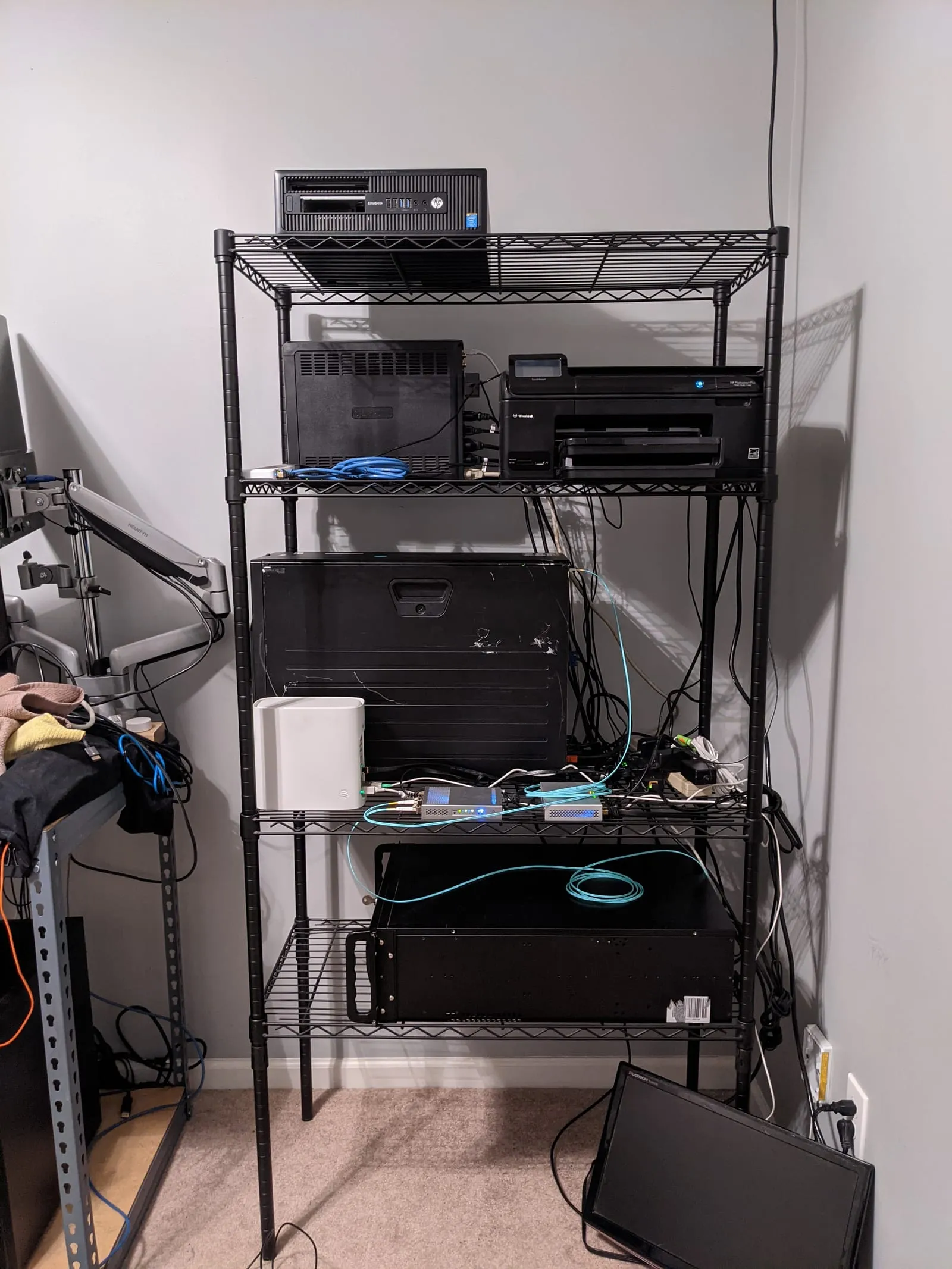
February 2021. The first “rack” was a wire shelf, and honestly it worked fine.
The pivot: Ceph and Swarm
The big jump happened fast, and recently. By late 2025 the lab had turned into a five-node Proxmox cluster with real hardware behind it. pve-00 is an EPYC 7282 with 256 GB of ECC in a 4U hot-swap chassis. pve-01 is that Threadripper. Three repurposed HP small-form-factor boxes fill out quorum and soak up whatever is left. Underneath all of it is a Ceph cluster, around 232 TiB raw across a pile of spinning disks, NVMe, and a couple of Intel Optane drives for metadata.
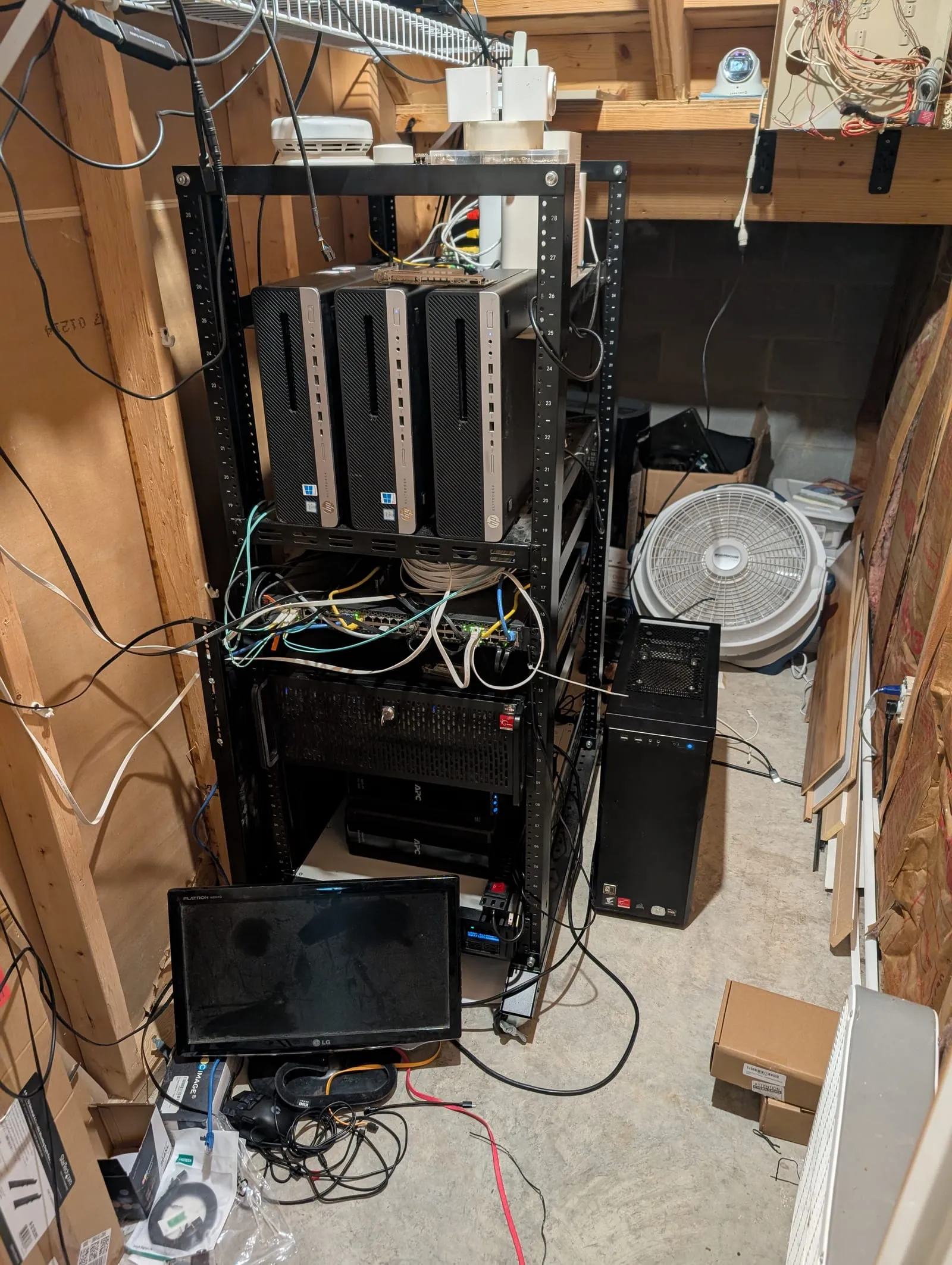
Late 2025, in the basement. The three HP minis are stacked up top, the EPYC flagship is the 4U unit under the switch, and pve-01 is the tower on the floor, still in the reused case from my old gaming PC. A box fan handles the thermals.
Storage is also where I collected most of my scars.
Before Ceph I ran ZFS on each node with GlusterFS as the shared layer, and Gluster and I have history. Split-brains. Corrupted shards I would have to track down by hand, repair, and then wait on, because distributed storage repair runs on its own schedule and does not care about yours. Migrating off ZFS-and-Gluster onto Ceph was its own multi-week saga, usually kicked off by an otherwise routine Proxmox upgrade deciding to get interesting at 3am.
A couple of lessons from that era are permanent. Backups are not optional, and “I have backups” is not the same sentence as “I have tested restores.” I learned the difference the way everyone does. And SQLite on a network filesystem is a trap. I tried running service databases as SQLite files on Gluster, and network shares and SQLite get along about as well as you would expect, which is to say not at all. More than once the fix was literal database surgery, or reaching for open-source tools like the Plex dbrepair script, which I ended up sending fixes back to.
Orchestration in this era was Docker Swarm, and by the end it was running close to a hundred containers. Swarm carried the lab a long way. But at that scale I kept hitting the walls the internet had warned me about. Routing that still pointed at containers that had already moved, and recovery that was slower and less predictable than I could live with when real people were on the other end of it.
Kubernetes
When Swarm started showing its limits, Kubernetes was the obvious next step. Obvious and daunting, which is why most people circle it for a while before committing. It is a real jump in complexity. But the failure modes I was fighting were the exact ones Kubernetes is built to handle, so eventually I stopped circling.
Now, its nine Talos Linux nodes, GitOps through ArgoCD, Ceph underneath, and GPU workloads spread across three different NVIDIA generations. The migration was also my chance to do the separation I had always wanted and never had the runway for. Dedicated tiers for authentication, for databases, for GitLab and CI, plus a security and honeypot layer to actually watch what is happening on the network.
This is also the first evolution I did with an AI agent in the loop, and that is not a footnote. Having an AI pair in the editor let me move through the migration service by service in a fraction of the evenings it would have taken by hand, while raising the bar on the design instead of just lifting and shifting the old one. I make the calls and own the debugging judgment. The agent helps me implement faster. Posts I write that way carry a tag saying so, and I am not going to be cagey about it.
What it was always for
Strip off the rack and the specs and the acronyms and the reason has not changed. I do this because building it and understanding it is fun, and because the automation pays me back every day. The lights come on before I am awake. The media shows up. The services my friends use mostly stay up. And the lessons have a way of turning up in the day job whether I planned for them or not.
I skipped a lot here. The Google Workspace exodus, the specific outages, the hardware itself. Those get their own posts. There is even an old Linux Mint image floating around somewhere that I might boot up just to see what Docker looked like back when this whole thing was one node and a list of ideas.
For now, that is the arc. A $75 firewall to a Kubernetes cluster, one evolution at a time.
It’s probably fine.
How this one was made. The arc is mine and I have been telling pieces of it for years. What I couldn’t do from memory was date it, so the timeline was reconciled against photo-dated artifacts instead: build photos, file timestamps, hardware that pins itself to a year. Where a memory and a file disagreed, the file won.
The first version of this read like a machine wrote it, list-shaped and full of em dashes, and it was rewritten before it went up. What came after that was factual correction rather than voice, and they were the same corrections the rack tour needed, because the two were drafted together off the same pile of photos.